

BIG WEEK AHEAD
IM BACK WITH THE DAILY NEWSLETTERS

WEEKLY MARKET OUTLOOK: Friday’s nonfarm payrolls report for November will be in focus this week as investors try to assess whether the U.S. economy is remaining resilient in the face of higher interest rates. Oil prices look set to remain volatile and central bank meetings in Australia and Canada could underline the view that rates have peaked.
1. Nonfarm payrolls
Markets will be eagerly awaiting Friday’s November jobs report to see whether economic growth is continuing to level off. Too strong a number would undercut bets that the Fed will begin loosening its restrictive monetary policy earlier than expected, presenting an obstacle to the fourth quarter rally in stocks and bonds.
A weak number, on the other hand, could spark fears that the economy is cooling following 525 basis points of rate increases, potentially dampening risk appetite. Economists expect the U.S. economy to have added 180,000 jobs in November, after 150,000 jobs were created in October.
Separately, data on Tuesday is expected to show the number of job openings moderating in November while Thursday’s initial jobless claims report will be watched for any signs of an uptick in the number of people out of work.
2. Santa rally?
U.S. stocks rallied and the S&P 500 closed at its highest level of the year on Friday, starting December on an upbeat note as investors grew more confident the Federal Reserve is done with rate hikes following comments from Fed Chair Jerome Powell. Powell vowed to move "carefully" on interest rates, describing the risks of going too far with tightening as "more balanced" with risks of not controlling inflation.
Some investors currently see a strong chance of the Fed delivering a rate cut as early as March 2024 but the market has misread the Fed and economic conditions several times in recent years and may be doing so again. There will be no updates from Fed officials during the week as the central bank enters the traditional blackout period ahead of its Dec 12 - 13 meeting.
3. Oil volatility
Oil prices slumped more than 2% on Friday on investor skepticism about the depth of OPEC+ supply cuts and concern about sluggish global manufacturing activity. For the week, Brent posted a decline of about 2.1%, while U.S. crude lost more than 1.9%.
OPEC+ producers agreed on Thursday to remove around 2.2 million barrels per day (bpd) of oil from the global market in the first quarter of next year, with the total including a rollover of Saudi Arabia and Russia's 1.3 million bpd of current voluntary cuts. OPEC+, which pumps more than 40% of the world's oil, is reducing output after prices fell from about $98 a barrel in late September on concerns about the impact of sluggish economic growth on fuel demand.
The cuts are voluntary, so there was no collective revision of OPEC+ production targets. The voluntary nature of the cuts led to some skepticism about whether producers would fully implement them, and from what basis the cuts would be measured.
4. Central bank decisions
The Reserve Bank of Australia is expected to keep interest rates on hold at its latest policy meeting on Tuesday following a rate hike last month and after data last week showing that inflation slowed in October. But investors are wary of a hawkish hold, with prices still elevated and new Governor Michele Bullock increasingly seen as more of a hawk than her predecessor.
Elsewhere, the Bank of Canada is expected to keep rates unchanged for a third straight meeting when it meets on Wednesday. Recent data has shown that the country’s economy contracted in the third quarter, indicating the central bank’s aggressive rate hikes are working to curb growth. Investors may also get some fresh insights on when the Bank of Japan might begin its own, much-delayed tightening campaign from Tokyo CPI data on Monday.
Whether business and the economy could even weather a return of higher interest rates will also be clearer from the Tankan corporate sentiment surveys and GDP data on Thursday.
5. Eurozone data
In the Eurozone, a speech by President Christine Lagarde on Monday will be closely watched for any fresh insights on monetary policy ahead of the bank's upcoming meeting on Dec. 14. The ECB's pre-decision blackout period starts on Thursday. The bloc is to release October industrial production figures for France and Spain on Tuesday, followed a day later by Germany and Italy.
Meanwhile German factory order data on Wednesday will give an indication of whether the manufacturing sector in the bloc's largest economy is still in a downturn.
FUNDAMENTAL OUTLOOK: The S&P 500's rise to its highest level this year, and continued loosening of financial conditions via the falling dollar and bond yields should pave the way for a positive open for Asian stocks and risk assets on Monday.
The dollar shed 3% in November, its biggest monthly fall in a year, and last week fell for a third week in a row. The two-year U.S. Treasury yield slumped 40 basis points last week - its steepest fall since March - and the implied rate on December 2024 'SOFR' futures on Friday fell below 4% for the first time. That packs a powerful punch. Many will argue that the U.S. bond and rates markets have gotten far too carried away, and that the Fed will not ease so quickly and aggressively next year.
But Fed policymakers are now in their 'blackout period' ahead of the December 12-13 policy meeting. This means there will be no guidance from officials to take the wind out of investors' sails, certainly not on Monday, when the economic calendar is also very light. There would appear to be room for Asian equities to bounce back - by some measures, the region's underperformance has rarely been this bad in years. v The regional calendar highlights on Monday are New Zealand trade data and Australian inventories and corporate profit data, all for the third quarter. Economists polled by Reuters expect New Zealand's terms of trade to fall 1.9% on from the previous quarter, Australian inventories to fall 0.6%, and export volumes to slide 3.8%.
The economic and policy calendar for the rest of the week has plenty more potential market-moving moments, including interest rate decisions from Australia and India, inflation figures from South Korea, the Philippines and Thailand, and GDP from Japan, Australia and South Korea. On the policy front, the Reserve Bank of Australia on Tuesday is expected to keep its cash rate on hold at a 12-year high of 4.35%, according to 28 of 30 analysts polled by Reuters. The other two are going for a 25 basis point hike. New Zealand's central bank surprised markets last week with the hawkish rhetoric that accompanied its decision to leave rates on hold, and the RBA could echo a similar message.
In stark contrast to the Fed, rates futures markets are barely pricing in any rate cuts from the RBA next year at all. Indeed, the chance of a hike in the coming months is greater than the chance of a cut, current pricing shows.
TECHNICAL OUTLOOK: ES implied move setup
🏄🏾♂️ LONGS ABOVE TOP RANGE: 4606.25*** ( *you want a break and retest of top range to confirm longs* )
❌ *STOP LOSS: 4600*
🎯 ***TARGET 4619.25***
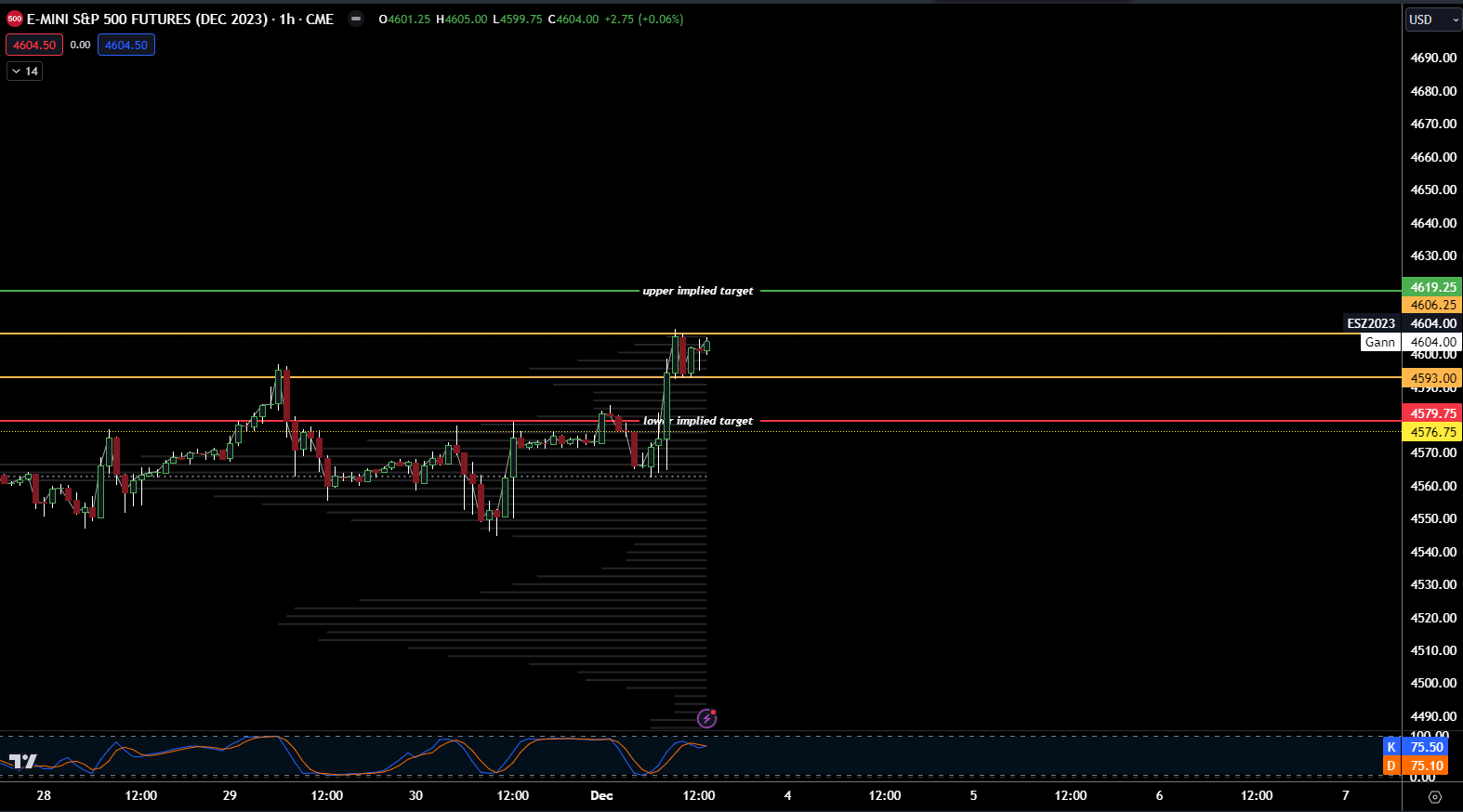
🧸 ***ES SHORTS BELOW: 4593*** ( *you want a break under and retest / hold under bottom range to confirm shorts* )
❌ *STOP LOSS: 4600*
🎯 ***Target: 4579.75***
NQ IMPLIED MOVE : 178
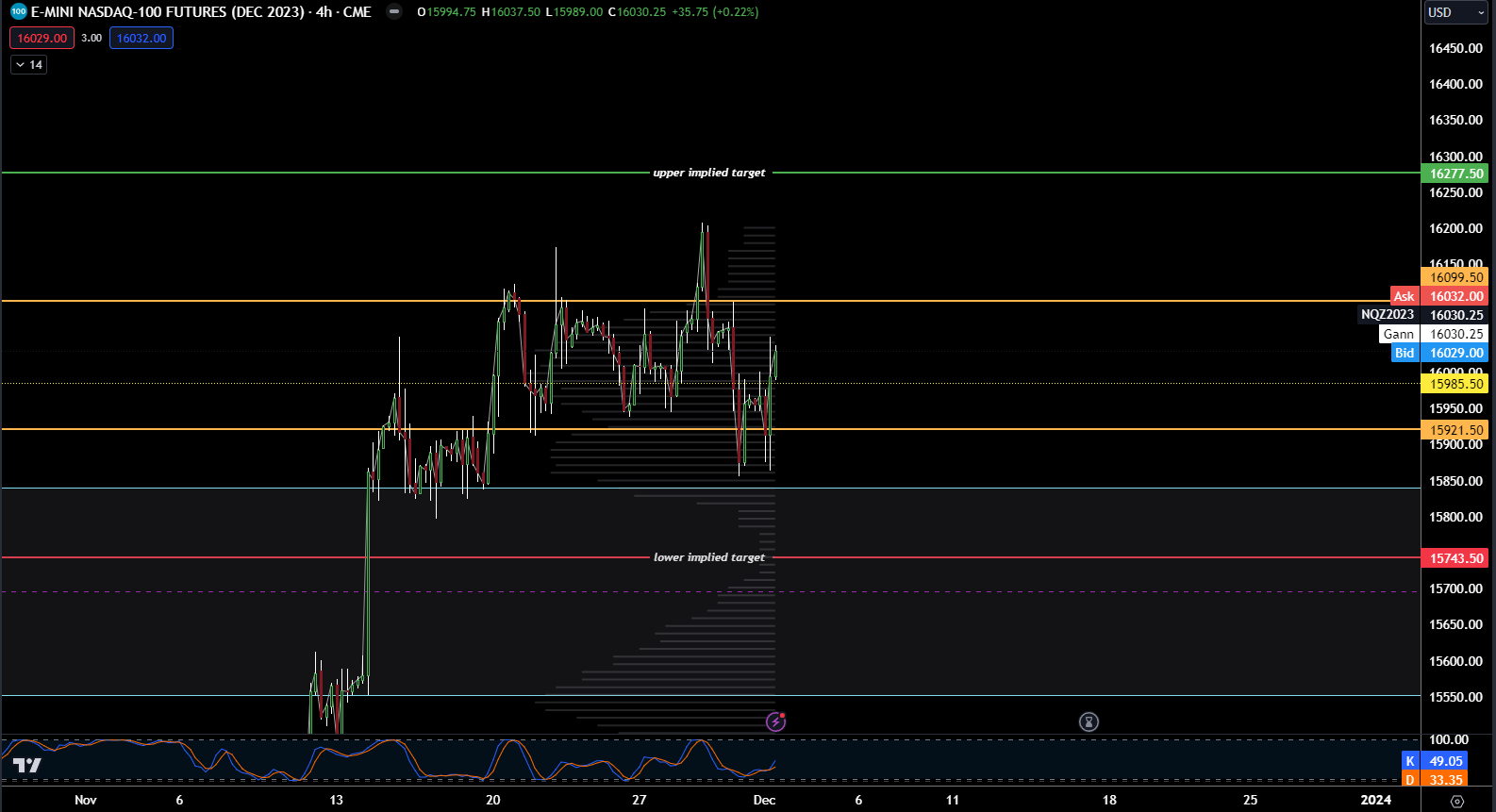
🏄🏾♂️ ***NQ LONGS ABOVE: 16099.25***
❌ *STOP LOSS: 15985*
🎯 ***TARGET: 16277.50***
🧸 ***NQ SHORTS UNDER: 15921.50***
❌ *STOP LOSS: 15984.25*
🎯TARGET: 15743